The Book — Out Now
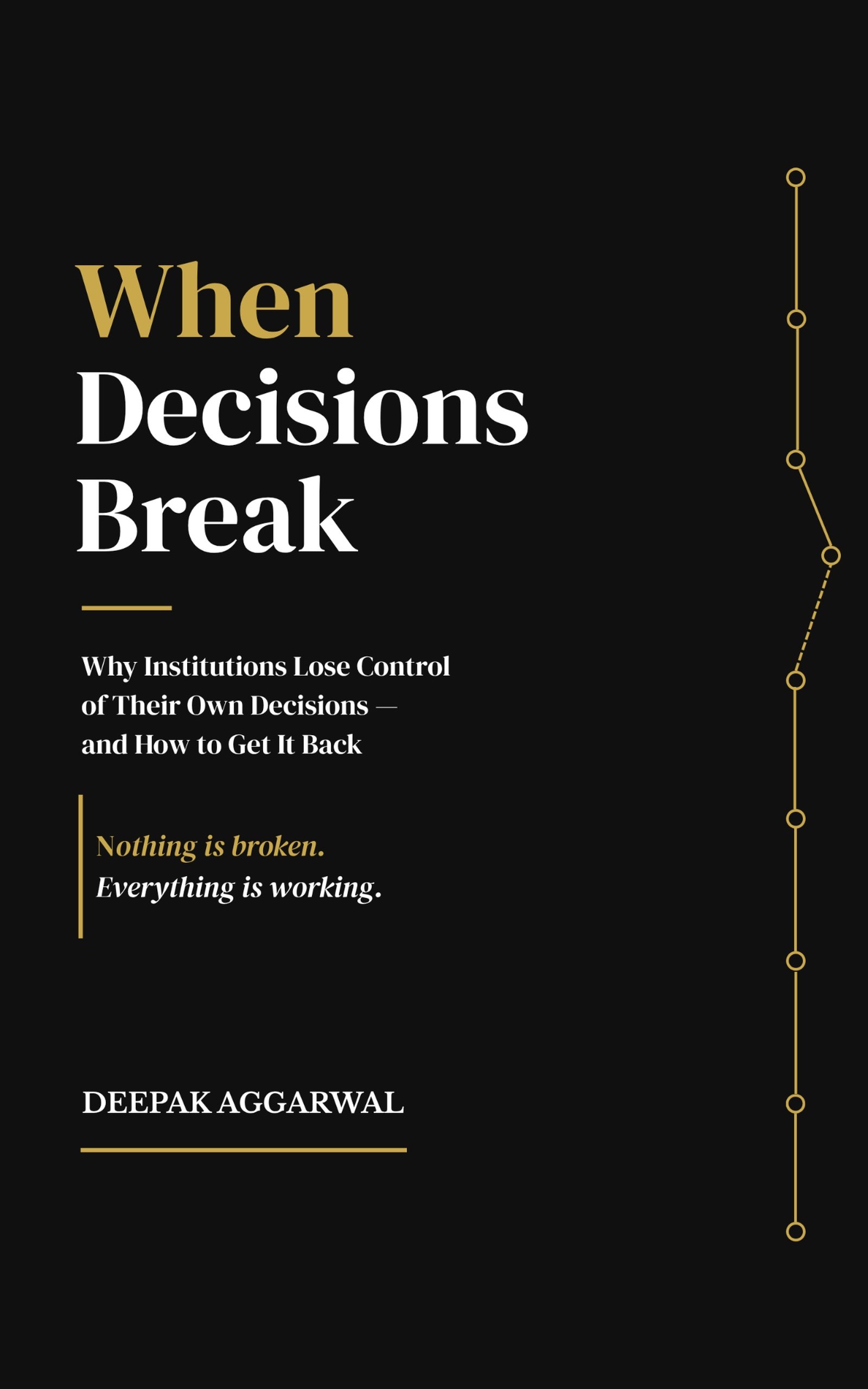
When Decisions Break
Why institutions lose control of their own decisions — and how to get it back. Two constructed case studies, from the boardroom to the front line.
Deepak Aggarwal · Singapore · Global
Decision Engineering™ for the agentic era
If you cannot replay a decision, you should not automate it.→
What does that mean? Show me a 30-second example ↓
Decision Engineering™ examines how institutional purpose and policy become actual human and automated decisions, where that chain breaks, and how control can be rebuilt.
It connects AI governance, model risk management and operational resilience at the level of the decision itself — the point at which a bank, insurer or health system meets the person affected by it.
For banks, insurers, healthcare systems and regulators navigating the shift from human judgment to AI-enabled execution.
// Decision replay · Knight Capital, 2012
A client’s authorised order was complete. But one server, running old software, continued sending orders.
Here is what each standard could tell the institution—and which one identifies the intervention point.
“Another order was sent.”
But should it have been?
“An old software function generated it.”
But was that function authorised to run that morning?
“After the incident, we discovered one server had not been updated.”
True — and only after it was over.
“The authorised order is complete. This next order has no authority. Stop it.”
Action, authority and intervention point — connected, while it still matters.
Most systems record what happened. Replayability shows whether what is happening is still what the institution decided.
See the full worked example → Facts from the SEC administrative order, Release No. 70694, 16 October 2013.// The problem
A board sets the purpose. Policies translate it. Teams interpret it. Data and technology encode it. People and AI systems execute it.
At every transition, the original decision can quietly change.
The result may be operationally correct, technically compliant and completely different from what the institution intended.
AI is moving from recommendation to authority. Decisions now travel faster, cross more systems and can be repeated at institutional scale before drift becomes visible.
An estimated 35–60% of the eventual loss came after the original error — during the period in which the institution could not see, reconstruct or stop what followed. The sample is small; the range needs wider testing. See the paper →
// What Decision Engineering™ does
Decision Engineering™ traces how institutional purpose becomes an actual decision through strategy, intent, rules and judgment. It asks whether the institution can reconstruct what was decided, who or what had authority, what shaped the outcome and who remained accountable.
Follow a decision from purpose and policy through people, systems and execution.
Replay the authority, rules, data, judgment and handoffs behind an outcome.
Define where authority sits, where accountability remains and where intervention is possible.
// The eight layers
The Decision Integrity Chain™ has eight layers. A consequential decision passes through all of them, in order: Purpose, Strategy, Intent, Rules, Judgment, Decision, Outcome and Feedback.
Authority is not a separate layer. Authority is assigned at the Decision node, which is why authorisation alone is not evidence of control.
The failures are rarely inside a layer. They are at the joins.
This work is built around the Decision Integrity Chain™, the Fiduciary Gap™ and replayability. The full explanation shows how they fit together and how Decision Engineering™ differs from AI governance, risk management, decision science and decision intelligence.
Read the complete explanation → The Decision Integrity Chain™ → Read the canonical definitions →Eight layers mapped. Three exposure points identified. One board-ready finding delivered. Fixed fee.
Send one decision your institution cannot fully reconstruct. I will tell you whether the audit applies.
Send it in confidence →Banking, healthcare, AI governance, operations and institutional transformation. Different industries. Different technologies. Different symptoms.
In almost every case, a decision problem sits underneath: who had authority, what the system was optimising for, who owned the outcome and whether anyone could reconstruct what happened.
The discipline emerged from repeated institutional patterns documented across sectors, technologies and failure types.
Explore the cases repository →// Three questions for the next governance meeting
Which important decision made in the last 90 days could your team not fully replay today?
Authority · rules · data · judgment
How long would it take to reconstruct a contested decision from 18 months ago?
Hours · days · weeks · unknown
Where is the written boundary of authority for the AI systems acting on your behalf?
If it is not written, it is an assumption.
// The practitioner behind the work
Founder, LumaThink, Singapore · Author, When Decisions Break
Deepak Aggarwal works on Decision Engineering™ applied to institutions, and developed the Decision Integrity Chain™ and the Fiduciary Gap™. Twenty-five years across banking, insurance, capital markets and healthcare, spent on how institutions turn purpose into the decisions their people and systems actually make. Based in Singapore.
// How the work evolved
For more than twenty-five years, I kept seeing the same break — a decision made at the top that had quietly changed by the time it reached execution. Every part could explain what it did. The outcome was still different from what the institution intended.
Decision Engineering™ emerged because the same break kept appearing.
Not separate projects — one line of development
Why institutions lose control of their own decisions — and how to get it back. Two constructed case studies, from the boardroom to the front line.
// Questions decision-makers ask
Direct answers for boards, banks and executives governing human and automated decisions.
// Choose your entry point
Understand the framework
Read the full explanation of the chain, the joins, replayability and the Fiduciary Gap™. Every term is defined once in the glossary.
Start here →Follow the thinking
Cases, research and short observations on institutions, AI and decision control.
Subscribe to Insights →Examine a live problem
Ten days. Eight layers mapped. One board-ready finding. Fixed fee.
Start the audit →
The views, analyses, and perspectives expressed on this site are solely those of Deepak Aggarwal, presented in a personal and independent capacity. They do not represent or reflect the views, policies, or positions of any current or past employer, client, institution, or affiliated entity.
All content on this site is provided for informational and educational purposes only. Nothing here constitutes legal, regulatory, financial, investment, or professional advice of any kind. Readers and visitors should exercise their own independent judgement and, where appropriate, consult a qualified professional before acting on any information or analysis presented here.
While reasonable care has been taken in the preparation of this content, no representation or warranty — express or implied — is made as to its accuracy, completeness, or fitness for any particular purpose. Information may be incomplete, subject to change without notice, and may not reflect the most current developments. No liability is accepted for any loss, damage, or consequence arising directly or indirectly from reliance on any content, analysis, framework, or opinion expressed on this site.
All institutional case references — including but not limited to SVB, Knight Capital Group, Theranos, Wirecard AG, Credit Suisse, Wells Fargo, Coutts, Orpea Group, Kaiser Permanente, and NHS entities — are cited solely on the basis of publicly documented regulatory findings, official investigations, court records, parliamentary reports, and other published primary sources. Theranos references are cited on the basis of CMS inspection findings (2015–2016), United States v. Elizabeth Holmes (No. 5:18-cr-00258, N.D. Cal.) and United States v. Ramesh Balwani (No. 5:18-cr-00258, N.D. Cal.). No non-public information has been used. All analysis is independent, educational, and analytical in nature.
Case studies and scenarios described as "constructed" or "composite" are hypothetical illustrations based on documented failure patterns. They do not refer to any specific institution, transaction, or individual beyond what is explicitly stated.
This site is not intended for distribution in, or use by, any person or entity in any jurisdiction where such distribution or use would be contrary to applicable law or regulation. Visitors are responsible for ensuring compliance with all laws and regulations applicable to them in their jurisdiction. No representation is made that content is appropriate or available for use in any particular location.
Decision Engineering™ as developed and presented in this body of work, together with the Decision Integrity Chain™, DIC™, the Fiduciary Gap™, FUSE™, STAGE™, DIC ChainTrace™, the Decision Trace Payload™, the Decision Drift Audit™ and associated original frameworks, diagrams and materials, is the intellectual property of Deepak Aggarwal. Unauthorised reproduction, adaptation or commercial use of these original materials is prohibited without prior written consent.
© Deepak Aggarwal 2025–2026. All rights reserved. Decision Engineering™ · Decision Integrity Chain™ · DIC™ · the Fiduciary Gap™ · Decision Drift Audit™ · DIC ChainTrace™ · Decision Trace Payload™ · FUSE™ · STAGE™ are trademarks of Deepak Aggarwal.